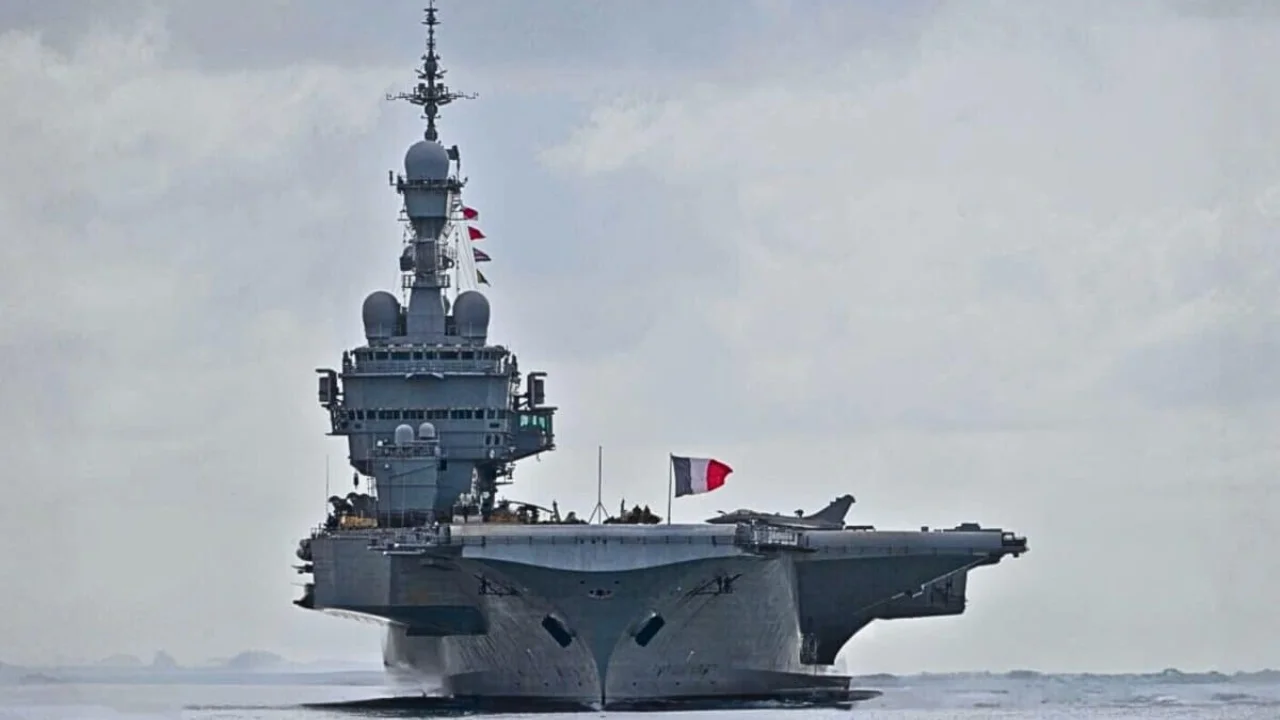
Charles de Gaulle Aircraft Carrier: Charles de Gaulle Aircraft Carrier is once again at the center of global naval attention as it heads into the Atlantic on a mission that experts describe as highly unusual. The Charles de Gaulle Aircraft Carrier does not move without reason, and when it does, defense analysts across Europe and North America take notice. This latest deployment from Toulon has sparked serious discussion about naval power, NATO cooperation, and the changing security map of the Atlantic in 2026.
In this article, you will understand why this mission is considered rare, what it signals strategically, and how the Charles de Gaulle Aircraft Carrier fits into France’s long term maritime plans. We will also break down the operational structure, security implications, and what this means for global trade routes, undersea cables, and European defense autonomy.
Charles de Gaulle Aircraft Carrier
The Charles de Gaulle Aircraft Carrier is France’s only nuclear powered aircraft carrier and one of the few operational nuclear carriers outside the United States. Commissioned in 2001 and regularly upgraded, it carries Rafale fighter jets, early warning aircraft, helicopters, and over 1,800 personnel during full deployment. When the Charles de Gaulle Aircraft Carrier sets course for the Atlantic rather than its usual Mediterranean operations, it reflects strategic calculation, alliance coordination, and geopolitical signaling. In 2026, the Atlantic is once again a zone of strategic competition due to submarine activity, energy routes, and the protection of transatlantic data cables. This deployment places France visibly at the center of that conversation and reinforces its position as a leading European naval power.
| Key Element | Details |
| Vessel Name | Charles de Gaulle Aircraft Carrier |
| Home Port | Toulon, France |
| Propulsion | Nuclear powered reactors |
| Aircraft Onboard | Rafale fighters, Hawkeye early warning aircraft, helicopters |
| Crew Size | Around 1,800 to 2,000 personnel |
| Deployment Zone | Atlantic Ocean |
| Strategic Focus | Sea lane security and alliance cooperation |
| Escort Formation | Frigates, supply ships, possible submarine support |
| Mission Type | Power projection and deterrence |
| 2026 Context | Rising Atlantic strategic competition |
Why the Charles de Gaulle heading west makes people sit up straight
The Atlantic Ocean is no longer simply a shipping highway between Europe and North America. In recent years, military planners have identified renewed submarine patrols, increased naval exercises, and growing concern over undersea infrastructure. According to current 2026 defense reports, more than 95 percent of global internet traffic travels through submarine cables laid across oceans. Many of those cables cross the Atlantic.

When the Charles de Gaulle Aircraft Carrier sails west, it sends a signal of presence and readiness. France is demonstrating that it can operate far from its coastal waters. This matters in a time when energy supply chains and maritime chokepoints are under close monitoring.
The Atlantic also connects Europe to major energy imports. Liquefied natural gas shipments, oil routes, and container trade depend on secure waters. A visible deployment reinforces deterrence and reassures allied partners that France is willing to shoulder responsibility in shared security spaces.
Naval officers have quietly acknowledged that such full scale Atlantic deployments are uncommon. The ship is more frequently seen in the Mediterranean, the Indian Ocean, or supporting operations in the Middle East. Moving west shifts the operational posture and broadens strategic reach.
Behind the rare mission: how a carrier strike group really moves
A carrier never travels alone. The Charles de Gaulle Aircraft Carrier operates at the center of a carrier strike group. This includes air defense frigates, anti submarine vessels, a replenishment ship loaded with fuel and supplies, and sometimes a nuclear attack submarine.

On deck, Rafale fighter jets are prepared for catapult launches. The E 2 Hawkeye aircraft monitors airspace from above, providing radar coverage hundreds of kilometers away. Below deck, engineers supervise the nuclear propulsion system that allows the ship to operate for extended periods without refueling.
Logistics are complex. The crew consumes thousands of meals daily. Aircraft require maintenance after every flight cycle. Communication teams maintain secure links with Paris and NATO command structures. Refueling at sea in Atlantic swells requires precise coordination.
The power of the Charles de Gaulle Aircraft Carrier does not only come from its fighter jets. It comes from integration. Every escort vessel has a defined role. Anti submarine frigates track underwater movements. Air defense ships monitor potential aerial threats. Together, they create a layered security shield.
In 2026, naval strategy increasingly emphasizes multi domain operations. That means coordination between sea, air, cyber, and space systems. This deployment allows France to test those capabilities in a real environment.

What this means for France, allies, and anyone watching the horizon
For France, this mission is a demonstration of strategic autonomy. European defense discussions often raise the question of whether Europe can act independently when needed. By sending the Charles de Gaulle Aircraft Carrier into the Atlantic, France shows that it can project force without relying entirely on external naval power.
For NATO allies, the deployment enhances interoperability. Joint exercises improve communication, tactical coordination, and readiness. It also spreads operational burden across multiple nations.
There is also a civilian angle that often goes unnoticed. The Atlantic seabed carries communication cables that support banking systems, online platforms, financial markets, and government communication networks. Damage or sabotage to these lines could cause serious disruption. Naval presence acts as a preventive layer of protection.
Energy infrastructure is another factor. Europe’s energy security depends heavily on maritime routes. A secure Atlantic ensures stable imports and reduced risk of interruption.

On board, sailors focus on daily responsibilities. Flight hours, sea state reports, maintenance checks, and watch rotations define their routine. Yet their mission connects directly to larger global stability. The Charles de Gaulle Aircraft Carrier becomes both a symbol and a tool of that stability.
FAQs
Why is the Atlantic deployment described as extremely rare?
The carrier typically operates in the Mediterranean or nearby regions. A large scale Atlantic mission with full escort formation is not common and usually reflects strategic necessity.
How long can the Charles de Gaulle Aircraft Carrier remain at sea?
Because it is nuclear powered, it can operate for long periods. However, food supplies, aircraft fuel, and crew rotation usually limit missions to several weeks or months.
Does this deployment signal rising conflict?
Not necessarily. It is more about deterrence, readiness, and alliance cooperation rather than preparation for immediate conflict.

What aircraft operate from the carrier?
It primarily carries Rafale fighter jets, E 2 Hawkeye early warning aircraft, and helicopters for search and rescue or anti submarine missions.
Why should civilians care about this mission?
Atlantic sea routes carry trade goods, energy supplies, and digital communication cables. Their protection directly affects economic stability and daily life.