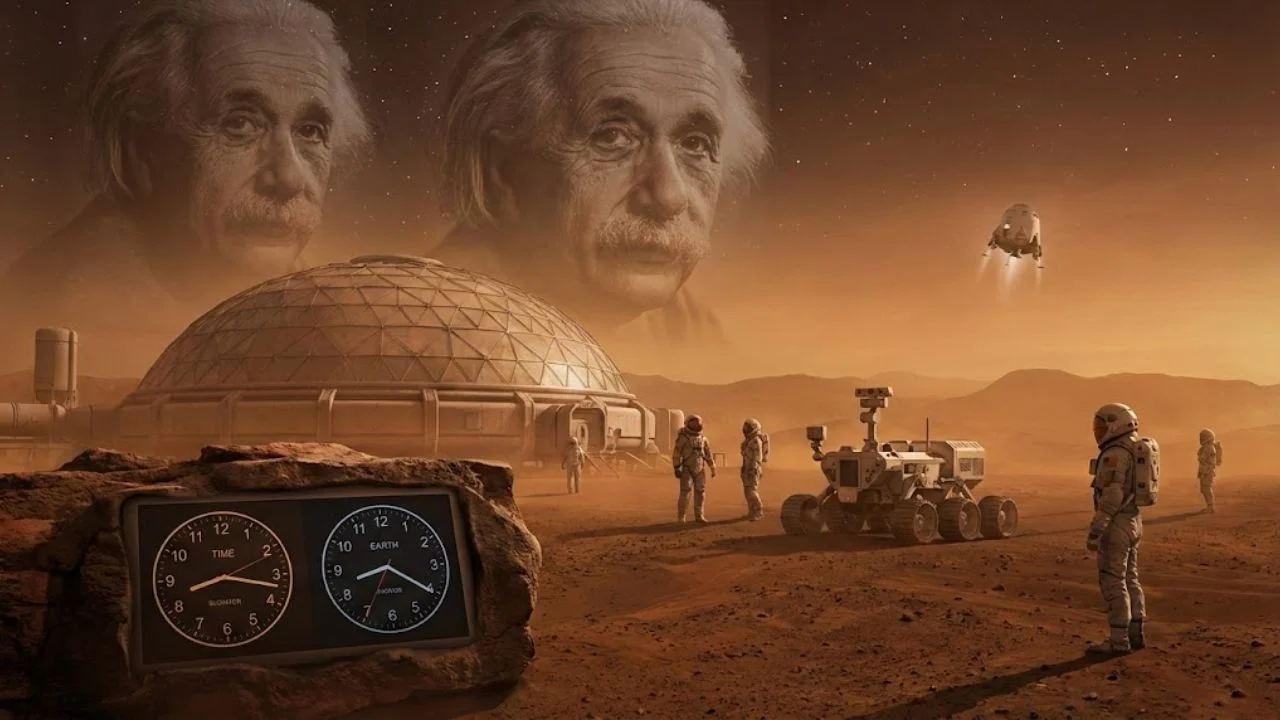
Time Flows Differently on Mars: Time Flows Differently on Mars and that is no longer just a bold scientific claim. It is a practical reality that space agencies are dealing with right now. Engineers working on Mars missions have seen firsthand how Time Flows Differently on Mars, not in dramatic science fiction style, but in subtle shifts that affect schedules, software, and human sleep cycles. What once lived in physics textbooks is now shaping real mission planning in 2026.
In this article, you will discover why Time Flows Differently on Mars, how Einstein predicted this outcome long before spacecraft ever touched the planet, and why future astronauts will need a completely new time system. We will break down the science in simple language, explore real mission experiences, and look at how upcoming Mars exploration programs are preparing for a planet where even the clock ticks differently.
Time Flows Differently on Mars
When scientists say Time Flows Differently on Mars, they are speaking both scientifically and practically. A single Martian day, known as a sol, lasts 24 hours, 39 minutes, and 35 seconds. That extra 39 minutes may seem harmless, but over weeks it shifts work schedules, biological rhythms, and communication windows with Earth. On top of that, Mars has only about 38 percent of Earth’s gravity. According to Einstein’s theory of general relativity, weaker gravity slightly changes how time passes. Add Mars’ unique orbit and rotation speed, and you get a planet where clocks must constantly be corrected. This is not theory anymore. It is part of mission software, spacecraft navigation, and future human survival planning.
Overview of Martian Time Differences
| Key Factor | Why It Matters |
| Length of a Martian sol | 39 minutes longer than Earth day, shifts daily schedules |
| Mars gravity at 38 percent of Earth | Causes measurable time variation under relativity |
| Einstein’s general relativity | Predicts time changes with gravity and motion |
| Orbiter speed around Mars | Requires constant onboard clock corrections |
| Communication delay with Earth | Complicates scheduling across two planetary clocks |
| Solar powered systems | Depend on accurate sunrise and sunset timing |
| Human sleep cycles | Struggle with longer daily rhythm |
| Mars Coordinated Time proposal | Aims to create a unified Martian time standard |
| 2026 mission planning tools | Now integrate relativity corrections by default |
| Future human colonies | Must rely on Mars based timekeeping for safety |
Einstein’s Weird Clock Meets the Martian Day
More than a century ago, Albert Einstein explained that time is not fixed. It bends depending on gravity and speed. On Earth, we barely notice these effects because everything around us shares the same environment. On Mars, conditions are different.
Mars has weaker gravity and a different orbital path around the Sun. That means clocks on Mars tick at a slightly different rate compared to clocks on Earth. The difference is small, but in space navigation small errors grow quickly. A tiny timing mismatch can shift a spacecraft’s landing point by kilometers.

Orbiters circling Mars move at high speeds while passing through varying gravitational forces. Their internal clocks must be adjusted frequently. Without those corrections, navigation systems would slowly drift off course. This is one of the clearest examples showing that Time Flows Differently on Mars in a measurable and operational way.
Living on Mars Time: Lessons from Curiosity
When the Curiosity rover landed in 2012, engineers decided to live on Mars time to better coordinate daily operations. Every day, their work schedule shifted 39 minutes later. At first, it felt exciting. It was like participating in a global scientific adventure.
After several weeks, exhaustion began to show. People were coming to work in the middle of the night according to Earth time. Families struggled to maintain normal routines. Sunlight outside no longer matched working hours inside mission control.
This experiment demonstrated something powerful. Even though the time difference seems small, human bodies are deeply connected to a 24 hour cycle. When Time Flows Differently on Mars, it affects mental focus, sleep quality, and overall performance. For short missions, it is manageable. For long term human settlements, it becomes a serious challenge.
Timekeeping as a Survival Tool for Future Martians
As space agencies plan crewed missions for the 2030s, the need for a Mars specific time system is growing urgent. Relying on modified Earth clocks will not be enough. Mars will need its own coordinated time standard.

Scientists are discussing a system often referred to as Mars Coordinated Time. This would function like Earth’s global time standard but adjusted for Martian conditions. Orbiters or dedicated satellites could broadcast precise time signals across the planet.
Why does this matter so much? Because survival systems depend on timing. Oxygen production units, water recycling systems, power grids, and greenhouse lighting cycles must align with the Martian sol. If Time Flows Differently on Mars, then every critical system must follow that rhythm exactly. Even small mistakes could reduce safety margins in an environment that does not forgive errors.
New Mission Planning Tools for Mars
In 2026, mission software already includes automatic relativity corrections. Engineers do not manually calculate these differences anymore. The systems handle it in the background.
Future astronaut smartwatches may display two clocks. One for Mars local time and one for Earth time. Earth time will mostly serve as a reminder of home rather than an operational guide.
Communication scheduling also becomes more complex. Messages between Earth and Mars can take several minutes to travel. When you add planetary time differences, coordination becomes a balancing act between two worlds.

Training programs are expected to include psychological preparation for living in a slightly longer day cycle. Humans will need to adapt their thinking. When Time Flows Differently on Mars, daily life from meal times to maintenance checks must shift accordingly.
Living Inside Einstein’s Equation
There is something deeply human about this story. Time shapes our identity. Birthdays, workdays, weekends, and seasons structure our lives. Moving to Mars means stepping into a different rhythm.
A Martian birthday would arrive 39 minutes later each year compared to Earth. Over decades, that difference becomes noticeable. Colonists will live in a world where sunrise, sunset, and the ticking of clocks follow a new tempo.
Einstein once described time as local. Mars proves that idea in a practical way. Time Flows Differently on Mars, not dramatically, but enough to demand new systems, new habits, and new thinking.
FAQs
1. Does time actually move slower on Mars?
Yes, but only slightly due to weaker gravity and motion differences. The bigger noticeable change is the longer Martian day.

2. How long is a day on Mars?
A Martian sol lasts 24 hours, 39 minutes, and 35 seconds. That extra time shifts schedules gradually.
3. Why did Einstein’s theory matter for Mars missions?
Einstein showed that gravity and speed affect time. Mars missions must apply these corrections to keep navigation accurate.
4. Will Mars have its own time zone system?
Scientists are developing a unified Mars time standard that future colonies can use reliably.
5. Why is precise timekeeping critical for astronauts?
Life support, landing coordination, and energy systems depend on exact timing. Small errors can create serious risks on Mars.