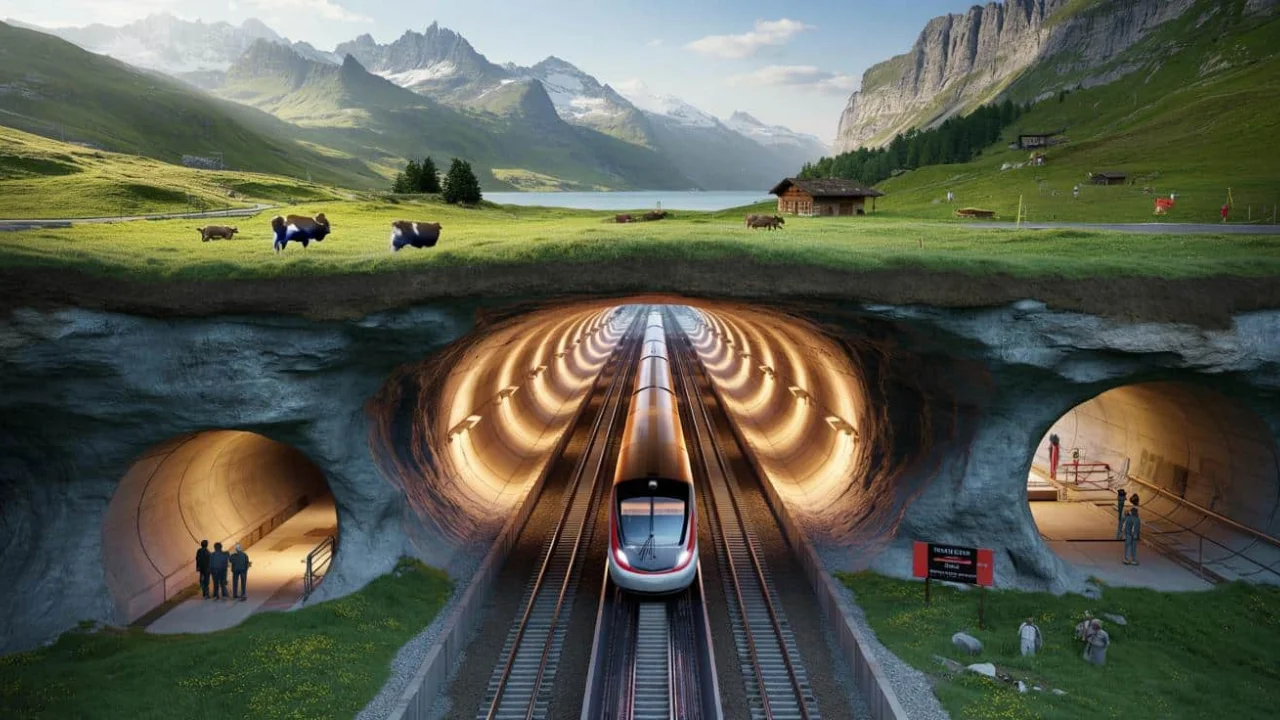
Switzerland Underground Infrastructure: Switzerland Underground Infrastructure is one of the most fascinating engineering stories of modern Europe. Beneath the calm Alpine landscape lies a hidden system that most travelers never think about. When a train slips into a mountain and reappears on the other side right on time, that smooth journey is powered by the massive Switzerland Underground Infrastructure built carefully over decades.
If you have ever wondered how a small, mountainous country became a transport powerhouse, this deep dive will give you clear answers. In this article, you will discover how tunnels like the Gotthard Base Tunnel changed European rail traffic, why Switzerland invested billions below ground instead of building more highways, and what lessons cities around the world can learn from this underground strategy.
Switzerland Underground Infrastructure
Switzerland Underground Infrastructure is not just about digging tunnels. It is about long term planning, environmental protection, economic strength, and national security. Over nearly 30 years, Switzerland invested in base tunnels, service galleries, rail corridors, emergency passages, and mountain caverns that stretch for hundreds of kilometers. This network supports high speed passenger trains, heavy freight transport, water systems, and critical technical operations. Unlike many countries that focus only on surface expansion, Switzerland mapped its underground space as carefully as its cities. The result is a resilient transit system that reduces truck traffic in Alpine valleys, shortens travel time between northern and southern Europe, and protects fragile mountain ecosystems while maintaining world class reliability.
Overview of Switzerland Underground Network
| Key Aspect | Details |
| Construction Period | Nearly 30 years of steady tunneling |
| Longest Tunnel | 57 km Gotthard Base Tunnel |
| Major Purpose | High speed rail and freight transport |
| Environmental Goal | Reduce Alpine truck traffic |
| Safety Design | Parallel tubes with cross passages |
| Economic Impact | Stronger European transit hub |
| Security Role | Mountain bunkers and protected systems |
| Engineering Method | Tunnel boring machines and precision geology |
| Resilience Factor | Protection from weather and landslides |
| Public Support | Approved by Swiss voters in the 1990s |
The country beneath the country
When people picture Switzerland, they imagine lakes, snow peaks, and quiet villages. Few imagine a second network running under their feet. The Switzerland Underground Infrastructure includes world famous tunnels such as the Gotthard Base Tunnel, which opened in 2016 and stretches 57 kilometers through the Alps. It remains the longest railway tunnel on the planet.
Alongside it are the Lötschberg Base Tunnel and the Ceneri Base Tunnel, forming a powerful north south rail corridor. Together, these tunnels are part of a broader Alpine transit project that reshaped European freight movement in 2026. Trains now move goods between Germany and Italy faster and with fewer emissions.

What makes this system remarkable is not just length but complexity. Hidden maintenance corridors, ventilation shafts, escape routes, and technical chambers form an invisible web beneath the mountains. It is almost like a silent underground city built purely for movement and safety.
How do you quietly build a hidden megacity?
Building deep under solid rock requires patience. Swiss engineers began with years of geological research. Every layer of granite and gneiss was studied carefully. Test drills and digital models helped prevent costly mistakes.
Tunnel boring machines advanced slowly, sometimes only a few dozen meters each day. Behind the cutting heads, teams installed reinforced concrete segments, rail tracks, cables, and ventilation systems. Every 300 meters, cross passages connect parallel tunnels. These are critical for emergency evacuation.
From outside, it looks simple. A tunnel entrance in a green valley. Inside, it is a high precision world of engineering discipline. This careful approach is why Switzerland Underground Infrastructure has become a global model for long rail tunnels and sustainable mountain transport.
Geography, money, fear, and reliability
Switzerland faced a serious challenge. Heavy European freight traffic crossed its mountains every year. Expanding highways would have damaged valleys and increased pollution. Instead of adding more trucks, the government pushed for rail freight through underground base tunnels.

Voters approved these rail investments in the 1990s. That long term commitment allowed completion of a flat, high capacity rail route under the Alps. By 2026, freight capacity through the Gotthard corridor continues to grow, reducing road congestion significantly.
Security also shaped the design. During the Cold War, Switzerland built protective bunkers inside mountains. That tradition of trusting solid rock influenced civilian infrastructure planning. Today, the Switzerland Underground Infrastructure benefits from natural protection against storms, landslides, and extreme weather.
Invisible but vital benefits
Most travelers never see the true scale of this underground network. They only feel the results.
• Shorter travel times between Zurich and Milan
• Reduced heavy truck traffic on Alpine passes
• Lower noise levels in mountain villages
• Fewer emissions in sensitive valleys
• Reliable schedules even during harsh winters
These benefits matter more than impressive engineering numbers. When trains arrive on time in all seasons, businesses and families can plan with confidence. That reliability strengthens Switzerland’s position as a central European logistics hub.

What this hidden network teaches the rest of us
The success of Switzerland Underground Infrastructure offers lessons beyond the Alps.
First, think long term. Major rail projects were completed over decades, not election cycles. That patience created a system rather than a patchwork.
Second, treat underground space as valuable land. Many cities ignore what lies beneath them. Switzerland mapped it carefully and used it strategically.
Third, communicate clearly. Swiss leaders focused on practical benefits such as minutes saved, noise reduced, and safety improved. People understood the value because it was explained in simple terms.
Fourth, invest in maintenance. Underground systems require constant monitoring. Switzerland treats upkeep as seriously as construction.

For cities facing congestion and climate pressure in 2026, this approach is increasingly relevant.
The strange comfort of a hollowed mountain
There is something reassuring about infrastructure that you rarely see. In an age where cities compete to build taller towers, Switzerland chose to go deeper.
The Alps once acted as barriers. Today, thanks to Switzerland Underground Infrastructure, they function as corridors. High speed passenger trains and heavy freight trains move quietly through mountains without disturbing the scenery above.
This hidden transformation supports tourism, protects nature, and strengthens trade at the same time. It proves that infrastructure does not need to dominate the skyline to change a nation.
FAQs
1. How long did Switzerland take to build its major base tunnels?
The largest projects, including the Gotthard corridor, took nearly 30 years from planning to completion.

2. Why is the Gotthard Base Tunnel important?
It is the longest railway tunnel in the world at 57 kilometers and forms a key part of Europe’s north south rail freight corridor.
3. Does Switzerland Underground Infrastructure only include train tunnels?
No. It also includes service galleries, technical rooms, ventilation systems, water conduits, and protective mountain caverns.
4. How does this system reduce pollution?
By shifting freight from trucks to electric rail transport, it lowers emissions and reduces noise in Alpine valleys.
5. Can other countries copy this model?
Countries without mountains can still adopt the long term planning mindset and prioritize rail based underground transport solutions.